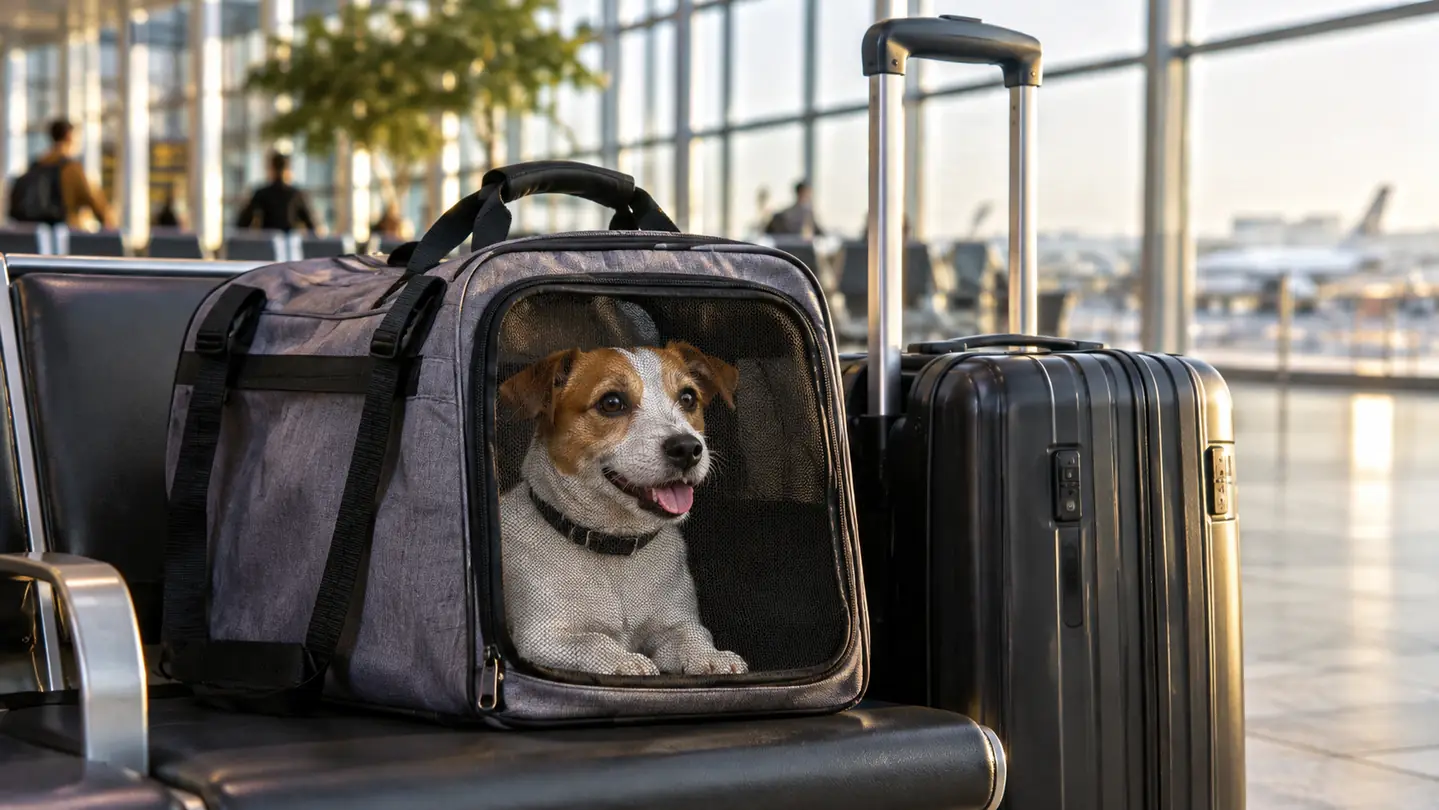
Pico is nine pounds, eight years old, and he has flown three round trips to Sacramento in the last fourteen months. He is also the reason I know that the hard part of flying with a small dog is not the flight. It is the month before it, when you are trying to work out which carrier the airline will actually accept and whether your dog will panic the second you close the zipper.
I am a retired dental office manager in Tucson, not a trainer and not a vet. I fly once or twice a year to see my sister, and the rest of the year Pico and I are on the road in a gray Subaru Forester doing motels and state parks. The carrier I keep coming back to is the Sherpa Original Deluxe in the small size, which I bought fourteen months ago before that first flight. It has been under the seat in front of me three times, and between trips it lives on the closet shelf. Here is the whole process in the order I wish somebody had handed it to me.
Small enough for the space under the seat, roomy enough that he naps in it
The Sherpa Original Deluxe, small, measures 15 by 10 by 8.5 inches and weighs about a pound empty, with a spring wire frame in the rear that pushes down to clear the seat in front of you.
Amazon Check Today's Price on Amazon →Step 1: Measure the Dog, Then Measure the Space Under the Seat
Measure him standing, not curled up in his bed. Nose to the base of the tail and floor to the top of his head, then write both numbers down where you will not lose them. Pico comes in around 13 inches nose to tail base and 9 inches at the shoulder. The Sherpa small is 15 inches long, 10 inches wide and 8.5 inches tall, which gives him room to turn around and lie down flat. A stocky 14-pound dog does not get that room, no matter what the weight limit on the airline's website told you.
Then measure the plane. Every airline publishes an under-seat allowance, and that number changes by aircraft and by seat. The same airline that hands you generous room on a mainline jet will put you on a regional jet where your own feet barely fit, let alone a bag with a dog in it. A window seat and an aisle seat are not the same space, and the bulkhead row is its own separate problem. Look up the rule for the exact flight you are booking, and if the carrier clears the published number with an inch to spare, you are in good shape.
The Sherpa is sold as airline approved and guaranteed on board. In three round trips nobody has ever pulled out a tape measure at the gate, and a gate agent in Tucson once told me it was the one she sees most often. That is worth something, but it is not worth betting a trip on. A manufacturer's guarantee is only as good as your own paperwork, because the person at the counter is reading the airline's rules off a screen whether you read them or not.
Step 2: Leave It Open on the Bedroom Floor for Two Weeks
The best thing I did was nothing at all. I set the carrier on the bedroom floor with the liner in and the zipper open, and left it there for two solid weeks. I dropped a piece of kibble inside every few days and then walked away. I did not put Pico in it. He is anxious in new places and he shakes for the first ten minutes of every car ride, and a dog wired like that does not need to be pushed into a bag. He needs to walk into it on his own and find out that nothing bad happens there.
By the end of the first week he was stepping in to get the kibble. By the end of the second he was napping in it with his chin hanging over the edge. That is when I started closing the zipper for five seconds at a time, then a minute, then carrying him from the kitchen to the living room by the padded top handle. Nine days into that, he rode in it to the vet's office and back without making a sound.
Skip this step and you will pay for it in the security line, in front of two hundred people, with your shoes sitting in a plastic bin.
Step 3: Add the Pet to the Reservation Before You Touch a Suitcase
A pet in the cabin is a reservation item, not a show up and hope item. Airlines cap how many animals can be in the cabin on any given flight, and once that number is reached you are not boarding with your dog, no matter how many times you have flown that route before. Add the pet when you book the seat, and call back if the confirmation does not say so in writing. While you have a person on the phone, have them confirm the carrier's maximum dimensions for that specific flight.
One more call worth making: ask what aircraft is scheduled. If the answer is a regional jet and there is an earlier flight on a bigger plane, take the bigger plane. I have done the small jet once and I would not do it again on purpose. The seat in front of me came down and back so close to my knees that I spent the whole hour with one hand on the carrier, checking that the frame had not popped back up.
I keep a folder on my phone with three things in it: the confirmation with the pet noted, the carrier's dimensions typed out, and the airline's pet policy saved as a PDF. Twice a gate agent has asked and twice I have had the answer in ten seconds. The people I have watched get stuck at the counter are the ones scrolling through their email with a dog in a bag under one arm.
Three round trips and the carrier has never been the reason I got stopped. The measuring tape was, and I only had to learn that once.
Step 4: Pack the Carrier, Not Just the Suitcase
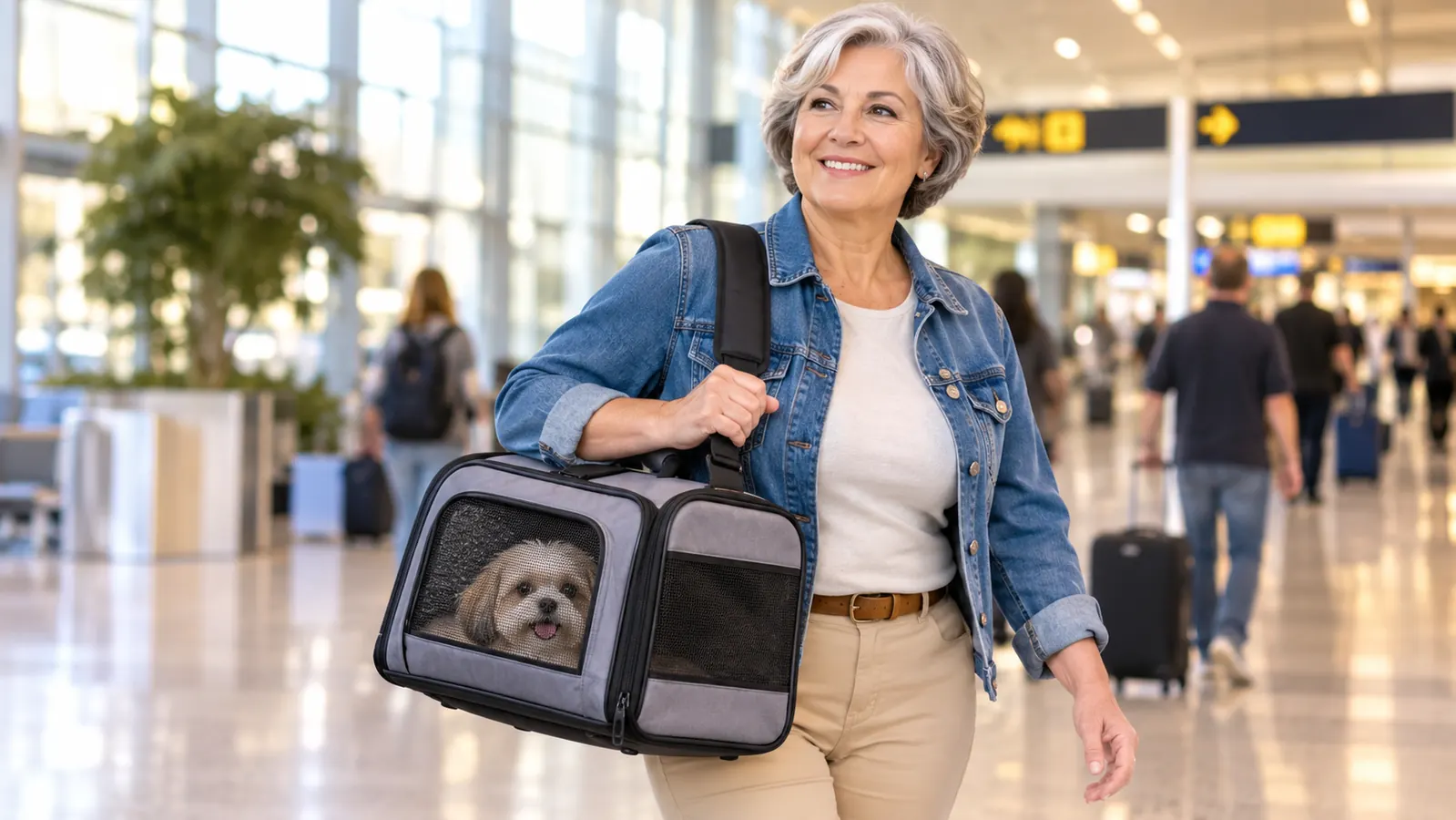
The carrier comes with a liner and a detachable shoulder strap, and both of them earn their place. The liner goes in on every trip and gets washed between them, because a liner that smells like a plane is worse than no liner at all. The strap goes over my shoulder at the airport so both hands are free for the boarding pass and the suitcase handle, and I unclip it and stow it once we are in the seat so it is not dangling into the aisle where a flight attendant will have to step over it.
Inside the carrier goes exactly one thing that smells like home, a worn t-shirt of mine, and nothing else. No bowl, no toy, no food. There is not room for any of it, and a dog who eats a full meal inside a carrier is a dog you will be cleaning up in an airplane bathroom the size of a coat closet.
The Cibaabo bottle with the bowl part and the food container rides in my personal bag, not in the carrier, and it gets used in the terminal after security. The COOYOO tether stays in the car, because the Sherpa is not a car restraint and I have never once used it as one. On the road, Pico rides in the booster buckled into the back seat and the carrier rides in the cargo area with the luggage. On the plane, the carrier is the entire system.
Step 5: Flight Day, From the Curb to the Space Under the Seat
I walk Pico longer than usual on the morning of a flight, feed him his normal breakfast well before we leave, and drive to the airport with him in the booster in the back seat. At the curb he goes into the Sherpa and he stays in it. I do not take him out in the terminal, not at the gate, not while we wait to board. A small dog on a leash in a busy concourse is a dog underfoot, and honestly he is calmer inside the bag than he is outside it.
Security is the one place he has to come out. I ask for a private screening room instead of doing it at the end of the belt, and the answer has been yes every time. It costs me four extra minutes and it saves both of us the spectacle.
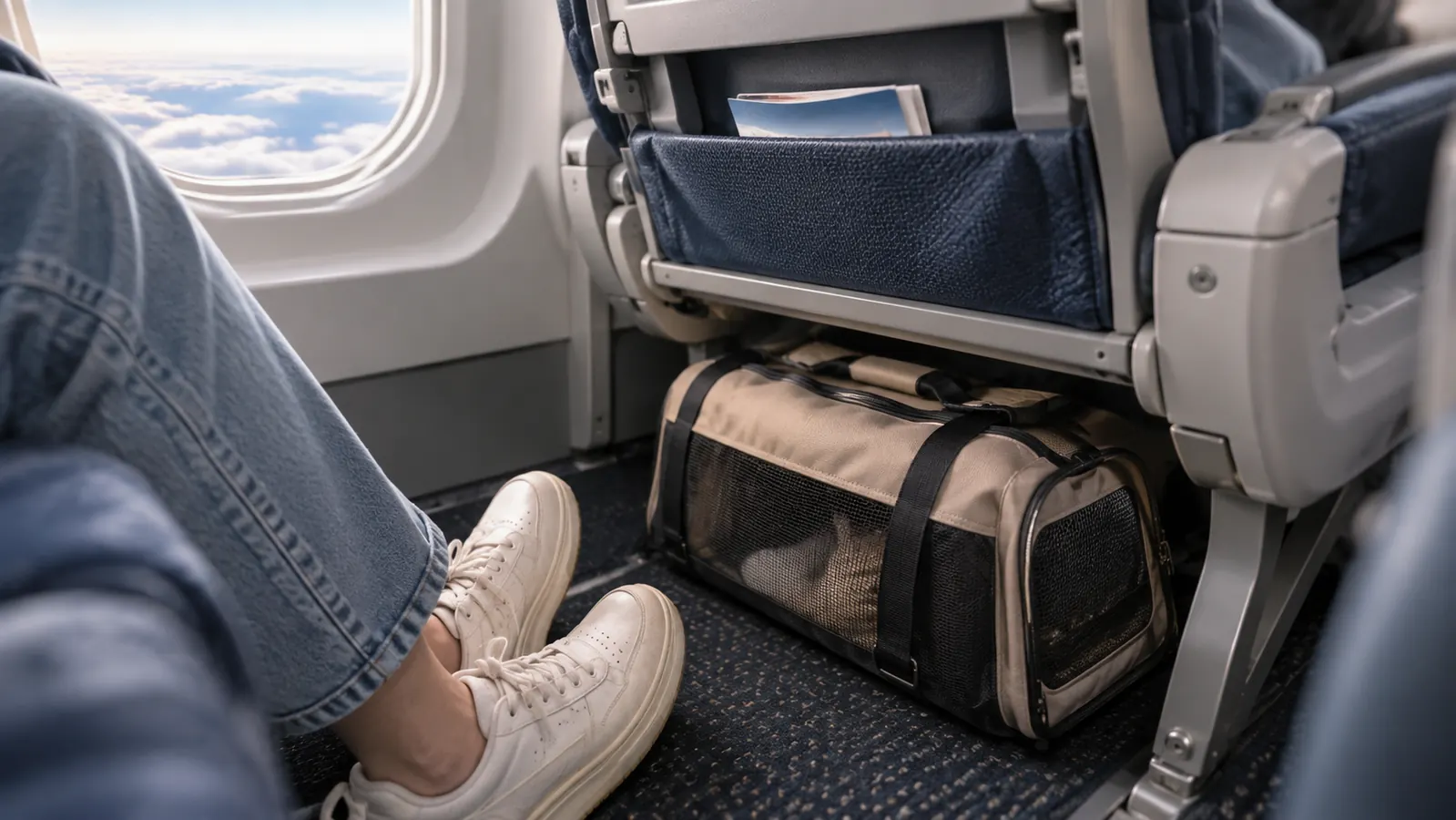
On board, the back of the carrier is the part that matters. The spring wire frame in the rear end pushes down several inches, which is how the whole thing slides under the seat in front of you instead of stopping at the lip. I push the back down first, slide it in, and let the frame come back up. Once it is under there he cannot see the aisle and he settles. I keep one hand on top of the carrier during takeoff, which is for me and not for him. Last trip he slept from wheels up to descent.
At the other end I carry him off the plane, through the concourse, and out the doors before I unzip anything. A dog who has been in a bag for four hours wants grass, not a baggage claim floor. The carrier goes back on the closet shelf when we get home, and the first thing I do is pull the liner out and wash it so it is ready the next time.
What Else Helps
Book the direct flight. Every connection is another gate, another agent, and another chance for something to go sideways with a dog in a bag. If the nonstop leaves at a worse hour, I take it anyway when Pico is with me.
Have the car side sorted before you have the plane side sorted. The Sherpa does flights, not drives. Pico rides in a booster that is strapped into the back seat with its own straps, and on the short drives when the booster is out being cleaned, the tether clips to the back ring of his padded harness, never to a collar, and buckles into the seat belt. That gear has nothing to do with the airline and everything to do with the four hours on either end of the trip.
Pack for the motel, not just the airport. The travel bed comes out of its stuff sack the moment we get to the room and goes on the floor beside my bed, and by the second night Pico is on it before I have finished setting my bag down. A dog who has somewhere familiar to land recovers from a flight faster than one who is improvising.
And know when to stop. If your dog panics inside the carrier at home after a couple of weeks of trying, a flight is not the place to work it out. Talk to your vet about it and take their answer seriously. If that answer is that he stays home with a sitter, that is a fine answer and not a failure. I got lucky. Pico took to the bag because I gave him two weeks to decide, and I would not have pushed it if he had not.
The carrier that has been under the seat in front of me three times
Small size, 15 by 10 by 8.5 inches, spring wire frame in the rear, liner and shoulder strap included. Start with two weeks on the bedroom floor and let the dog decide.
Amazon Check Today's Price on Amazon →