It happens on the second night in a motel outside Lordsburg, New Mexico. The first night Pico is so worn out from eight hours in the car that he drops wherever I put him. The second night he paces. Carpet by the door. Bathroom tile. The arm of the chair. Then he stands at the edge of my bed with his chin on the mattress and shakes, and I lie there at 11:40 listening to a truck idle in the lot and wondering why I decided a nine-pound Chihuahua mix belonged on a road trip.
A hotel room is not neutral ground for a small dog. I learned that the expensive way, one bad night at a time. The fix, for us, turned out to be a Furhaven Trail Pup travel bed in the small size, the one that comes with a stuff sack, plus about twelve months of trial and error around how I actually use it. The bed itself is not complicated. The routine around it is the part that decides whether your dog sleeps or stands at the door all night.
So here is what I would tell you if we were standing in a motel parking lot comparing notes. Five steps, in the order I do them, and a short list of the things that helped alongside them. None of it requires a special room, and none of it requires your dog to be the calm type. Pico is not the calm type.
The bed that ends the second-night pacing
A flat, packable mat that folds into its own stuff sack and lives in the cargo area until the room key comes out. Rated for dogs up to 28 pounds, 32 by 26 inches, small enough for a nine-pound dog to sprawl on.
Amazon Check Today's Price on Amazon →The Five Steps That Made Hotel Nights Predictable
Step 1: Unpack the Bed at Home Weeks Before the Trip
The single biggest mistake I made was opening the bed for the first time in a motel room. Pico sniffed it, looked at me like I had handed him a stranger's coat, and went and sat by the door. A bed that has never been inside your house has no history. To him it was just a pad on the floor with an unfamiliar smell, sitting in a room that already smelled wrong.
For the first three trips I used a folded bath towel from the motel instead, which he slept on about half the time and chewed a corner off the other half. That is not a bed. That is a placeholder.
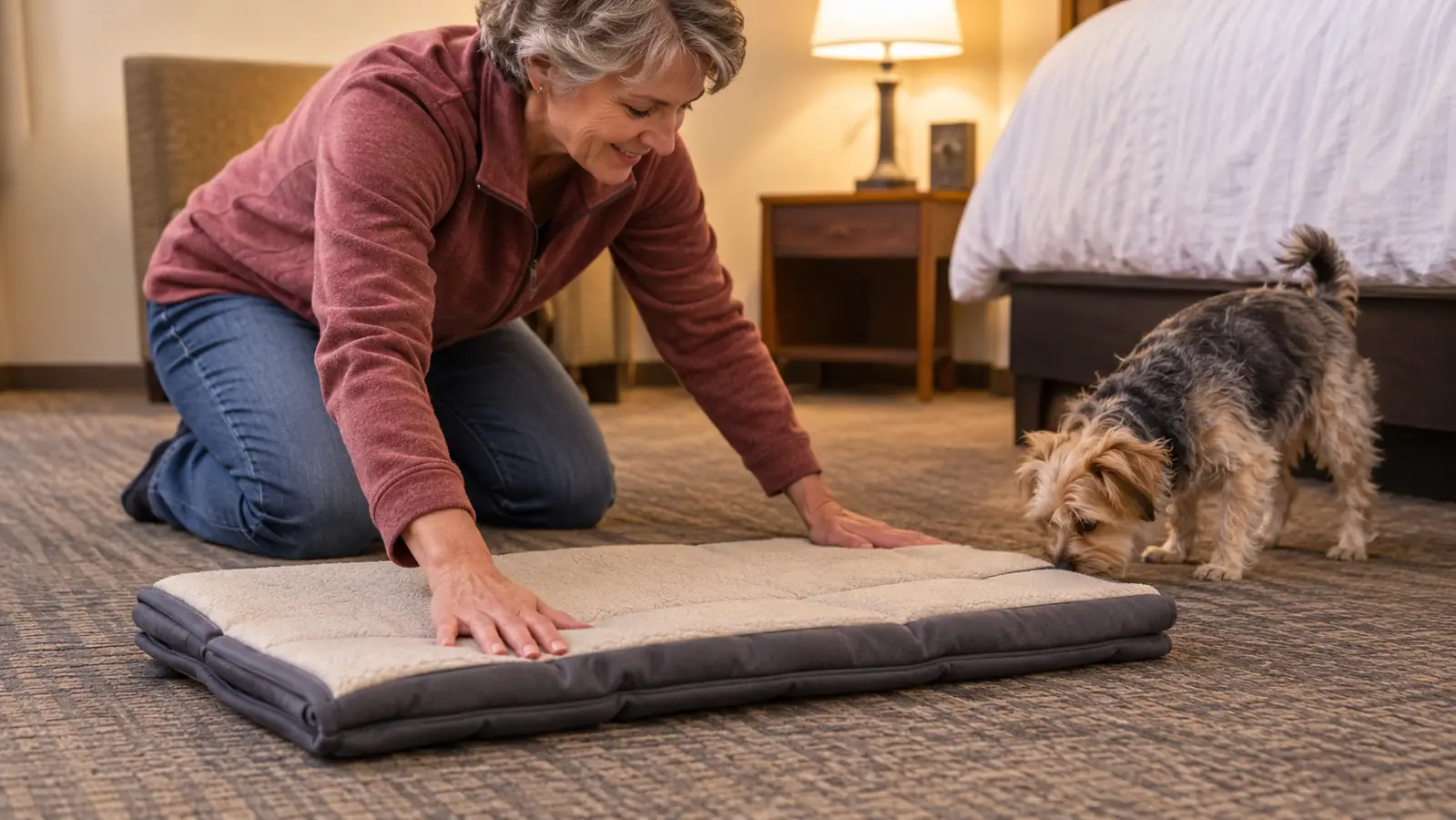
So now the bed comes out at home first. I set it on the living room floor near the chair where I read, I put one of my slept-in t-shirts on it, and I leave it there for a week or two. I do not make a fuss about it. I do not point at it and coax. I just let it collect the smell of the house and let him find it on his own schedule. By day four he was napping on it during my afternoon reading. By day ten he was choosing it over the couch, which for a Chihuahua mix is a real statement.
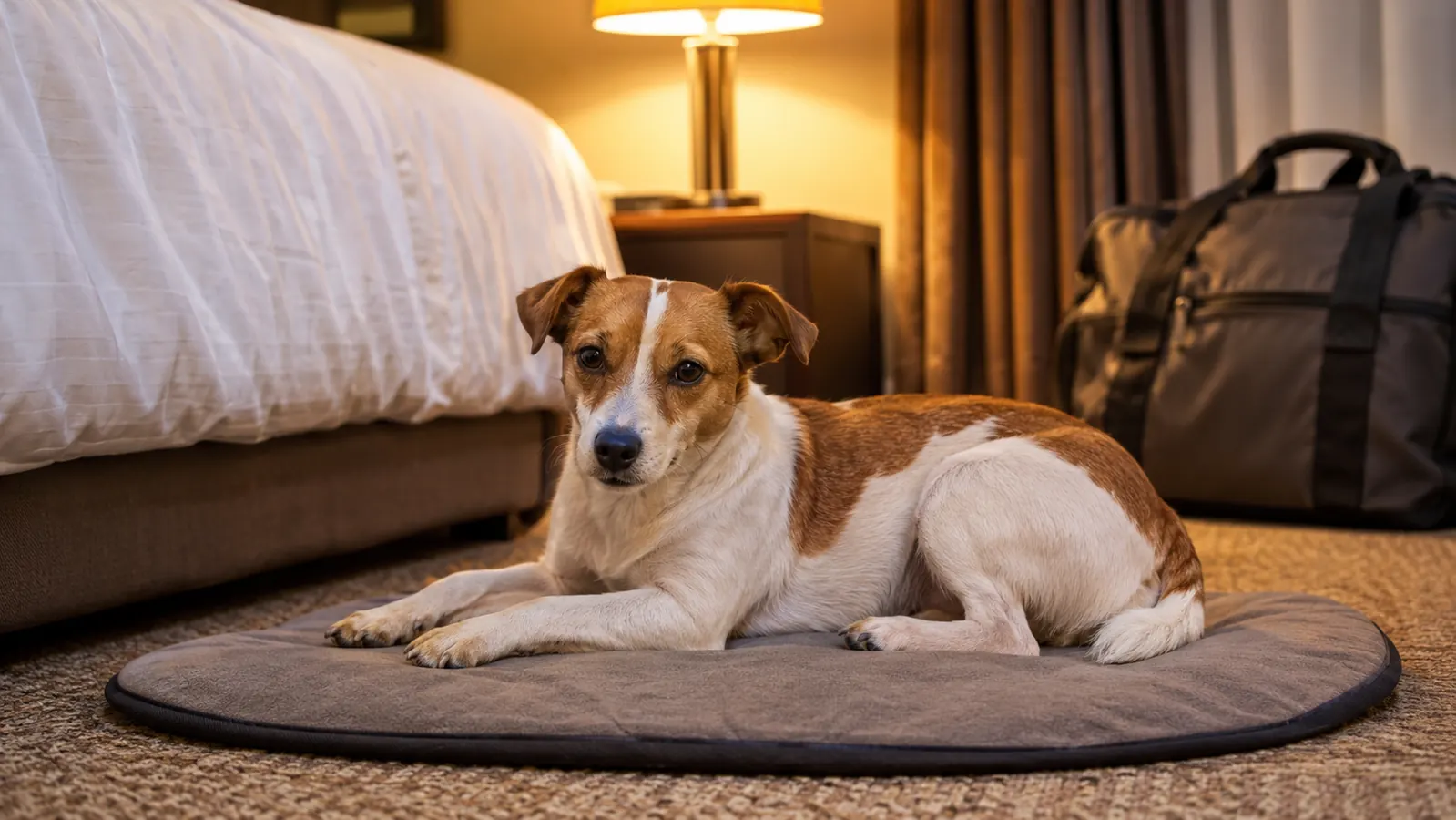
Worth knowing on fit: the Furhaven mat measures 32 inches long, 26 inches wide and 2 inches thick, in an oval shape, and it is rated for dogs up to 28 pounds. Pico is nine pounds, so he can stretch out and turn around without hanging off the edge. A small dog on a pad that is too short will sleep in a tight curl and wake up every hour, and then you will both be up at 4 a.m. listening to the ice machine.
Step 2: Pick the Spot in the Room Before Your Dog Does
Dogs do not choose sleeping spots in a strange room at random. They pick the spot with the best sightline to the door and the fewest surprises behind them. Left to his own devices, your dog will choose the bathroom threshold or the gap under the desk, and you will spend the night listening to him reposition on the tile.
My rule now is simple. The bed goes on the floor beside my side of the bed, against a wall, with a clear enough view of the door to satisfy him but not directly in the path of the AC unit. That last detail matters more than people expect. Hotel rooms run cold and the vents blow low. A nine-pound dog on a 2-inch mat on a hard floor gets chilled quickly, and a chilled dog does not settle no matter how tired he is.
It also helps to walk the room first. I move the desk chair back against the wall, I check that the closet door is fully closed so it does not rattle, and I clear the floor between the mat and the bathroom so he has a straight line if he needs to get up in the night. Ten seconds of furniture moving saves an hour of pacing.
Then I move the mat once, at most, in the first ten minutes. If he gets up and walks to the door, I do not follow him and I do not drag the bed over to the door to accommodate him. I wait. Dogs test. The dog who gets his bed relocated every time he stands up learns that standing up is the thing that works.
Step 3: Bring the Smell of Home, Not Just the Bed
The stuff sack matters less than what you put on top of the mat. I pack the bed, and then I pack one shirt I have slept in that has not been washed, and I put that shirt on the mat the first night in every new room. It sounds a little ridiculous when I write it out. It works better than any calming spray I have tried, and I have tried a few.
The other thing I do is resist washing the bed in the middle of a trip. Furhaven makes a point of the mat being washable, and it is, but washing it the night before a drive strips out everything your dog recognizes and turns his bed back into a stranger's coat. I wash it at home after a long trip, let it dry, and put it back in the sack. On the road it stays exactly as it is, dog hair and all.
If you are flying, this is where the carrier and the mat split the job. My Sherpa carrier lives on the closet shelf between trips and does the work of getting Pico through the airport and under the seat in front of me. The mat does the work of telling him the room is his once we are there. I do not put the mat inside the carrier. It does not sit right in there and it turns the carrier into a different object than the one he already trusts.
By day four at home he was napping on it during my afternoon reading. By day ten he was choosing it over the couch.
Step 4: Deal With the Sound and the Light Before Bedtime
Motel walls are thin in a way that is almost impressive. Ice machines cycle. Trucks downshift on the highway. Somebody in the hall at 6 a.m. has a rolling suitcase with a bad wheel. A dog who is already keyed up hears all of it and treats every sound as information that requires a response.
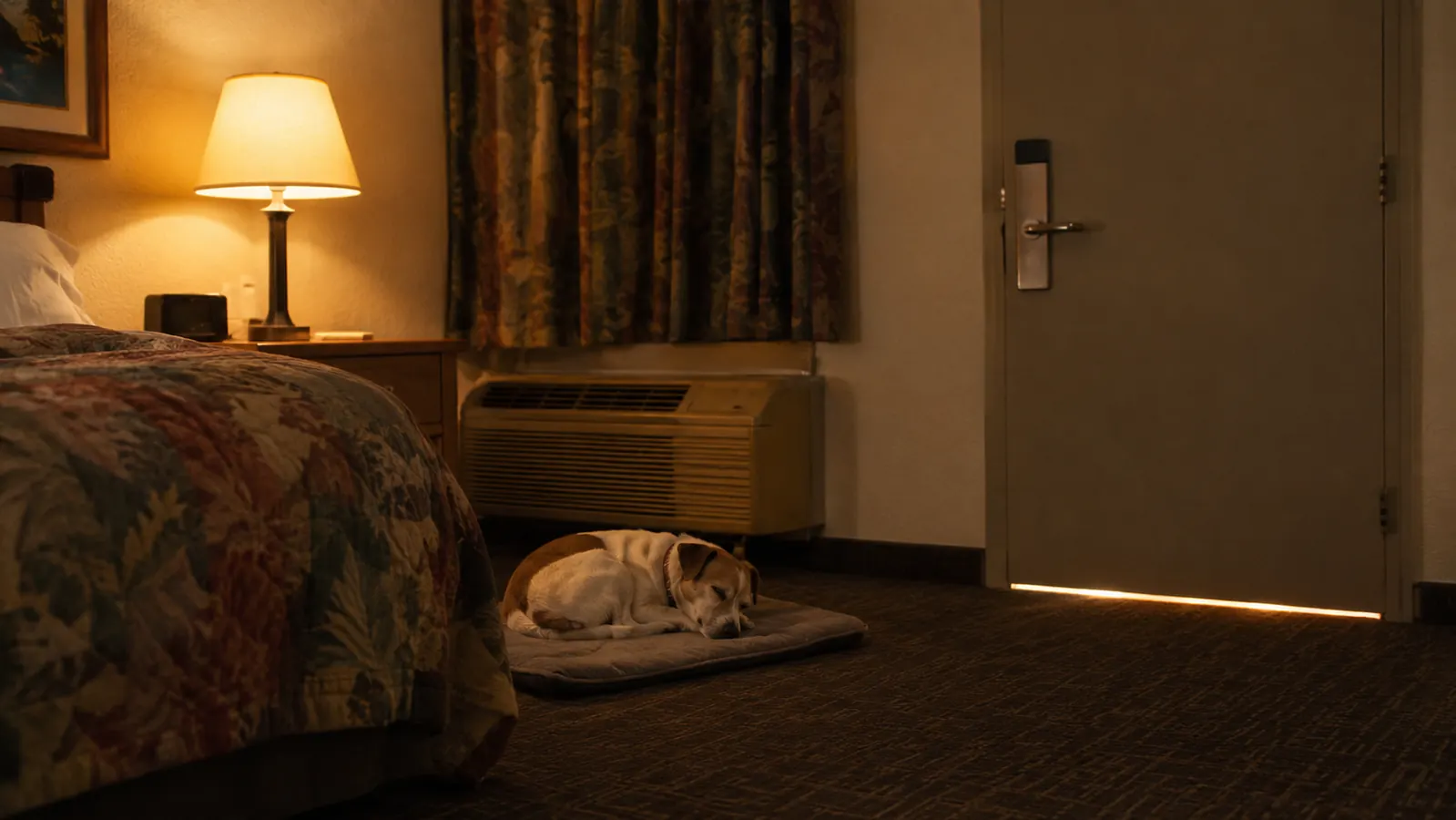
Two cheap fixes handle most of it. First, I set the room's fan or AC to run continuously instead of cycling on and off, so there is a steady wash of noise rather than a series of starts. Second, I leave the bathroom light on with the door mostly closed, so there is a dim line of light and the room is never fully dark. Pico settles faster with a little light in the room. Total darkness in a strange place makes him alert, not sleepy.
The third fix is timing, and it is the one people skip. I take him out for a real walk before bed, not a quick pee by the ice machine. Twenty minutes of sniffing a sidewalk does more for his night than an hour of me telling him to lie down. Then we come back in, I put the shirt on the mat, and I get into bed and stay there. My own moving around is the number one thing that keeps him up.
One more thing about the door. If there is a gap under it, he will watch it. Rolling a towel along the bottom takes four seconds and cuts out most of the hallway light and a good share of the noise, and it stops him from startling awake every time a door closes down the corridor.
Step 5: Give the Bed a Daytime Job Too
A bed that only appears at night shows up exactly when your dog is already wound up from a strange day. So I started putting the mat down in the afternoon too, at state park picnic tables, on the ground next to where I am sitting, and letting him lie on it while I eat lunch. Same bed, different place. The message is that this thing is his everywhere, not just at bedtime.
This is where the Furhaven mat earns its spot in the cargo area of the Forester. It folds into the stuff sack, it weighs a little over 14 ounces so I never think about it, and it does not care about gravel, picnic tables or the tile by the motel ice machine. After a stop I shake it out, fold it, and put it back. It has held up over twelve months of that, and the fabric has not gone flat or torn at the seams.
The washing routine at home is genuinely easy. I run it through with the regular load, let it air dry, and it goes back in the sack in the cargo area until the next trip. That is the whole maintenance schedule. It is a flat mat, not a piece of furniture, and it behaves like one.
One honest caveat: this is a flat mat, not a bed with bolsters or sides. If your dog likes to burrow under something or press his back against a raised edge, a flat style will not give him that. Pico sprawls, so it suits him. If yours is a nester, layer a light blanket over the top of the mat or look at a different shape entirely. Buying a flat mat for a dog who wants walls is how you end up with a bed in the closet.
What Else Helps
Water and food on a schedule, not on request. The Cibaabo bottle rides in the Forester's cup holder with kibble in the attached container, and I offer it at every rest stop whether or not he asks. A dog who is even slightly dehydrated sleeps badly and wakes up cranky. I hand-rinse the bowl part at the motel each evening so it does not sit overnight with residue in it.
Keep the order of operations identical every night. Walk, water, shirt on the mat, bathroom light, bed. Dogs are small pattern machines, and the pattern is doing more work than any single item in my car. By the fourth night on the road, Pico was heading to the mat on his own before I had my shoes off, and that is the whole goal.
Settle on one side of the room. If you are traveling with someone, decide who the dog sleeps next to before you leave and do not change it mid-trip. On the one night I put the mat between two beds, Pico spent the night rotating between them and nobody in that room slept.
And keep your own expectations low for night one. The first night in a new room is usually fine because everyone is tired. Night two is where the real adjustment happens, so that is the night to be boring, be in bed early, and not run out for ice at 10 p.m. and wake the dog back up.
One mat, every motel room, twelve months in
32 by 26 inches, 2 inches thick, rated for dogs up to 28 pounds, and it folds into its own stuff sack between stops. This is the one that comes out of the cargo area in every room from Tucson to Durango.
Amazon Check Today's Price on Amazon →