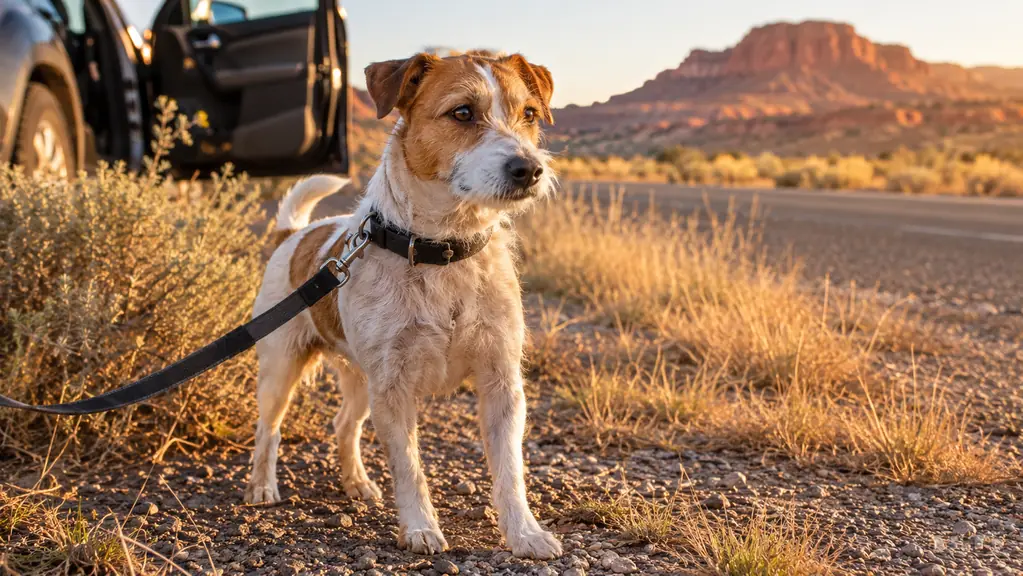
The first time I drove from Tucson up to Colorado with Pico in the back seat, I packed a collapsible bowl, a thermos of water from the kitchen tap, and a bag of kibble. By the second rest stop the bowl had skidded across the parking lot, the thermos was too wide to pour one-handed, and Pico would not drink anyway. He is a nine-pound Chihuahua mix, eight years old, and deeply suspicious of anything that has not been in our kitchen first. That is the part nobody warns you about. A small dog does not collapse from thirst on a road trip. He just quietly stops drinking, and you find out four hours later when he is flat on the motel bed and will not take a treat.
Eight months ago I started carrying the Cibaabo dog water bottle, the 300 ml size, with the food container that attaches to the side. I am not going to tell you it fixed everything, because it did not. But it moved watering the dog from a two-handed production at the back of the car to something I can do with one hand at a stoplight. That mattered more than anything else I bought before it. Here is how I actually use the Cibaabo bottle, in the order I would explain it to a friend in a rest stop parking lot.
The bottle that lives in my cup holder instead of the cargo area
300 ml, a bowl part that fills when you tip it, a filter inside, and a 100 g food container on the side. One hand, no pouring, no bowl rolling across the gravel.
Amazon Check Today's Price on Amazon →Step 1: Find out how much water your dog actually drinks in a day
I never thought about this until I had to. At home Pico drinks out of a ceramic bowl in the kitchen and I top it up whenever it looks low, which means I had no idea what a normal day looked like for him. On the road that turns into guesswork, and guesswork is how you end up dumping a full bottle out at every stop because you cannot remember when he last drank.
So I did it the boring way. I filled the Cibaabo bottle to the top one morning before we left Tucson, offered it at every stop, and looked at what was left when we reached the motel. After three trips I had a rough picture. He takes a decent drink at the first stop, a smaller one at the second, and almost nothing after four in the afternoon. That is not a medical finding, it is just what my dog does. Your dog will be different. The point is to know your own number before you are standing in the sun trying to work it out.
The other thing I learned is that the food container is not decoration. Pico will take a drink more readily if there is a piece of kibble in the bowl part afterward, or if I rattle the container first. Eight months in, that rattle is the signal. He hears it, he comes over, he drinks. I did not train him to do that on purpose, but I am not above using it. A hundred grams of kibble is not much, and it does not spoil a meal, which is why the container stays loaded between stops.
Step 2: Test the bottle in your driveway, not at a rest stop
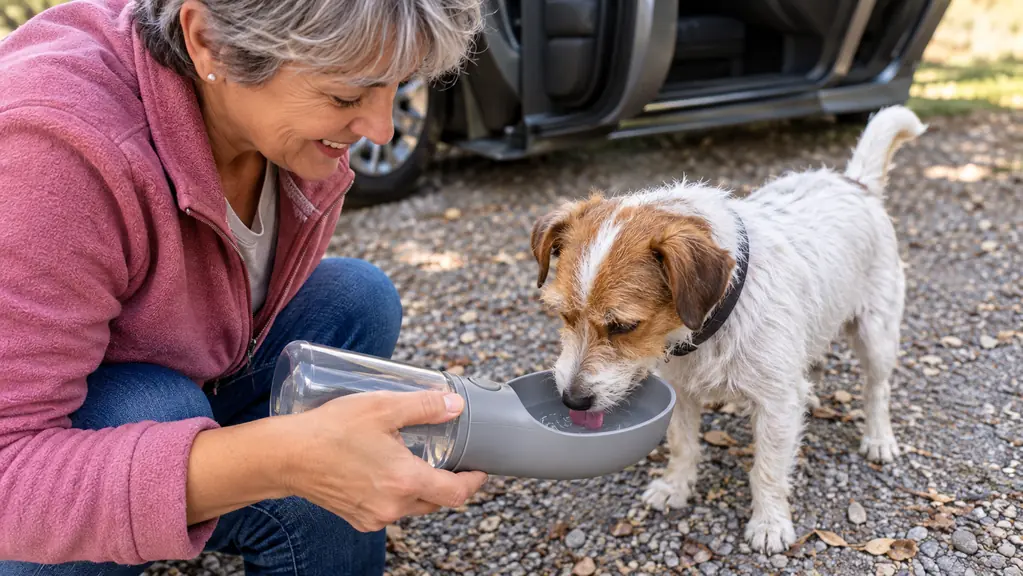
The first time you use any bottle with a bowl part, do it at home with the car parked and the engine off. I filled mine at the kitchen sink and carried it out to the Forester, and I am glad I did, because I got the angle wrong twice. Tip it too far and the water comes out faster than a nine-pound dog can drink. Tip it too little and nothing reaches the bowl at all.
The Cibaabo bottle has a lock on it and a silicone ring between the bowl and the bottle body, and both of those exist to keep water out of your cup holder. That only works if you actually close the lock. I left it open once between Tucson and Phoenix and found out exactly how much of a 300 ml bottle can end up in a cup holder. Now I check the lock every time I set it back down, the same way I check that the back door is shut.
The filter is the other piece I had to get used to. It sits inside the bottle and does its job on tap water from a strange sink, which is what you get at most rest stops between here and the Colorado line. I rinse it every night along with the rest of the parts and let it air dry. That is the whole maintenance routine on the Cibaabo bottle. If you are expecting something more complicated than that, there is not one.
Step 3: Teach the dog to drink from the bowl part while the car is parked
Pico took to it on the second day, which surprised me. He would not drink out of a collapsible bowl at a gas station, but he would drink out of the bottle because he had already smelled it a dozen times in the kitchen. That is the whole trick, and it is not really a trick. Novelty is what spooks him. Familiarity is what gets him to drink.
So before your trip, leave the bottle on the floor where the dog can sniff it. Fill it, tip a little water into the bowl part, set it down, and walk away. Do that for a few days. Do not stand over the dog encouraging him, because that turns it into a thing that is happening to him. Pico is much more likely to drink from something I have ignored than from something I am presenting. The first night he drank out of the Cibaabo bowl part while I was in the other room, and I only knew because I heard it.
If your dog still will not take it, start with water they already know. Fill the bottle from your kitchen tap before you leave, so the first few drinks taste like home. After that, whatever comes out of the rest stop sink is fine, and the filter is doing what it can. I am not a vet and I am not going to pretend to be one. I am just telling you what worked with one stubborn nine-pound dog.
Step 4: Keep it within one hand's reach while you are driving
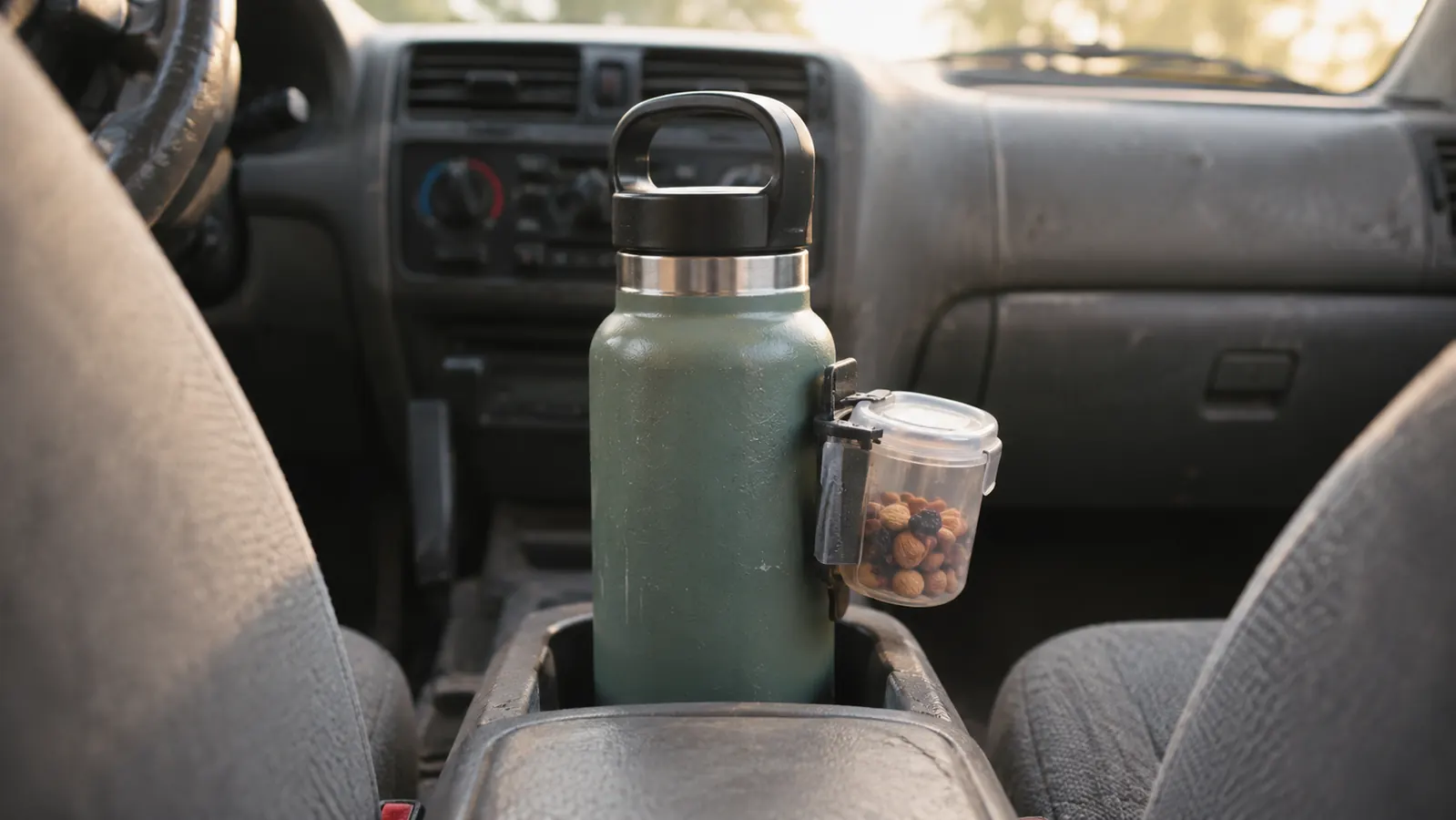
This is the part I got wrong for the first month. I had the bottle in the cargo area next to the travel bed, which meant that every time I wanted to offer Pico water I had to find a place to pull over, get out, walk around, and open the back. That is a ten-minute stop for a thirty-second drink, and after a while I just stopped doing it.
Now it rides in the cup holder between the front seats. The Forester's cup holder is deep enough that the bottle sits in it without tipping, and the food container on the side does not get in the way of anything. When we stop, I pick it up with my right hand, tip it with my thumb near the bowl, and hold it where Pico can reach it from the back seat. One hand, no getting out of the car. That single change is the reason the Cibaabo bottle gets used instead of admired.
That said, I do not hand it back to him while I am driving. I wait for a stop, or a red light on a quiet road. The bottle is not a toy and a nine-pound dog cannot hold it. Keep the ritual to parked moments and you will not spend an afternoon cleaning water out of a seat.
Step 5: Rinse it every night, and dry it before you close it up
Every motel room I stay in has a bathroom sink, and every night the bottle gets taken apart in it. Bowl part, bottle, filter, food container. Warm water, and no soap in the bottle itself if I can help it, because I do not want the next drink tasting like motel hand soap. The listing says the parts are dishwasher safe and I believe it, but I have never had a dishwasher on the road.
The important part is drying. If you screw the bowl back on while everything is still wet, you will open it two days later and know immediately that you made a mistake. I stand the pieces on a hand towel on the desk and put them back together in the morning. It takes four minutes, and it is the difference between a bottle you keep using and a bottle you throw away in Grand Junction.
The food container gets the same treatment, and I only put dry kibble in it. I tried a little canned food in there once. Once. It took two days and most of a roll of paper towels to get the smell out. Dry kibble, a rattle to get his attention, a drink, done. That is the whole routine, and it has not changed in eight months.
What Else Helps
The bottle solved the water part. The rest of the setup is what made the drives bearable. Pico rides in the back seat in a booster seat that lifts him enough to see out the window, and he settles in about ten minutes now instead of the thirty it used to take. That is not a hydration issue on paper, but a dog who is stressed in the car does not drink, so it is the same problem wearing a different hat.
I also stopped trying to water him at the car. At a rest stop I get him out, walk him to the shade, and offer the bottle there. Standing next to a hot hood in full sun is not a place any dog wants to drink. On the state park stops in Colorado I set the travel bed on the ground beside a picnic table and he lies on it while I hold the bottle. He is more willing to drink when he is settled than when he is still pulling at the leash.
One more thing, and it is the least popular advice I give. Offer water more often than you think you need to, and do not wait for the dog to ask. Pico does not ask. He will lie down and look at me and I will think he is being sweet, and he is actually just dry. The bottle lives in the cup holder so that offering is a five-second decision instead of a ten-minute stop. That is the entire reason it stays in the car, and the reason I would buy the same Cibaabo bottle again tomorrow if this one finally wore out.
Pico will not drink out of a strange bowl in a parking lot. He will drink out of the bottle he has smelled a hundred times in our kitchen, and that is the whole thing.
Eight months in, it is the one piece of gear I would replace the same day
300 ml bottle, bowl part, filter, and a 100 g food container that clips on the side. It rides in my cup holder from Tucson to Sacramento and comes out at every stop.
Amazon Check Today's Price on Amazon →