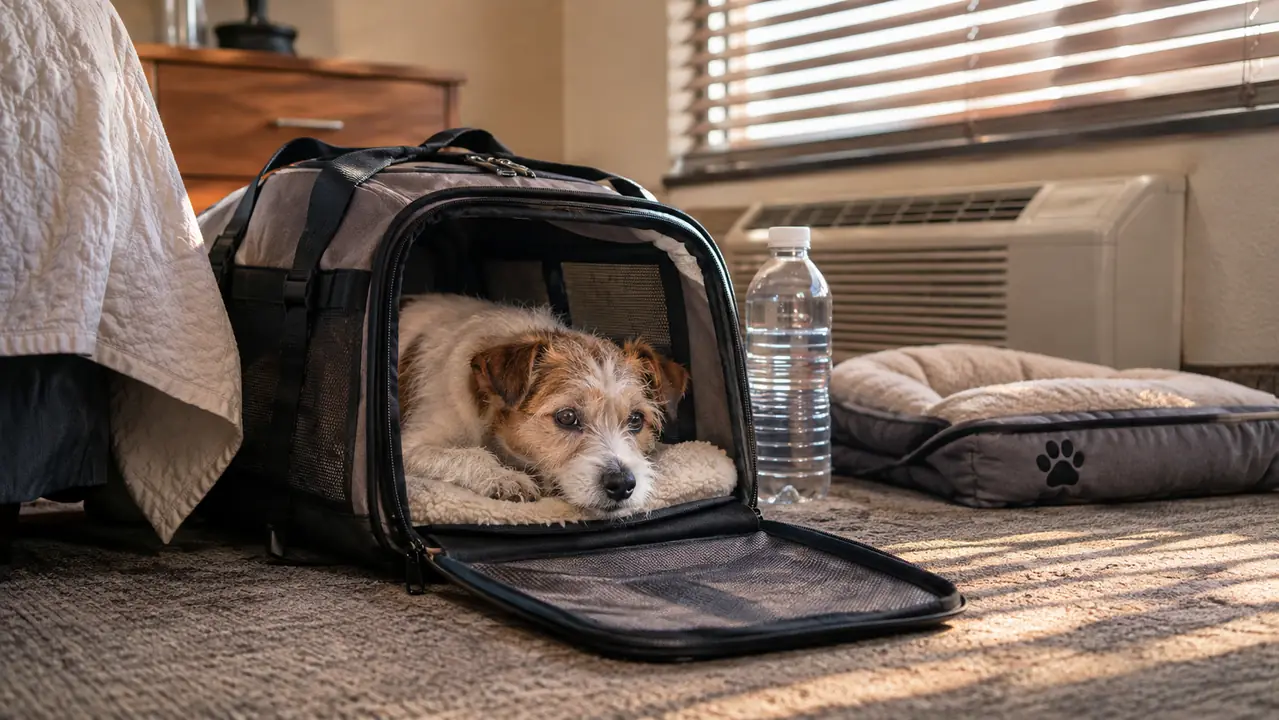
Nobody warns you that the hardest part of flying with a small dog is not the dog. It is the gate agent with the tape measure. I have stood at a boarding desk in Tucson with a carrier on my arm and a nine-pound Chihuahua mix inside it, doing arithmetic in my head about whether the thing would slide under the seat in front of me or get me sent back to the ticket counter.
I bought the Sherpa Original Deluxe fourteen months ago, before the first of three round trips to Sacramento to see my sister Dolores. I had read enough reviews to talk myself into it and enough reviews to talk myself out of it, which is the normal condition of anybody shopping for pet gear online at eleven at night. What follows is what I actually found after using it, including the parts I do not love.
The Quick Verdict
The carrier that gets you through the boarding door, with thinner padding and tighter interior space than the listing implies. Worth owning for flights. Not worth owning for anything else.
Amazon Check Today's Price →The carrier that survived three boarding desks without a single question
Fourteen months, three round trips, and the zipper still runs clean. If you fly a few times a year with a dog under fifteen pounds, this is the one that lives on my closet shelf between trips.
Amazon Check Today's Price on Amazon →What Nobody Tells You About the Sherpa Original Deluxe
The first thing nobody tells you is that the guarantee is about the carrier, not about your dog. Sherpa sells this as airline approved and guaranteed on board, and that matters, because it means the bag itself meets the size expectations most cabin crews work from. It does not mean the airline has agreed your particular animal is welcome on your particular flight. That part is between you, the airline's pet policy, and whoever is working the desk that morning.
The second thing is that a soft-sided carrier is not a piece of luggage. There is no rigid frame holding its shape. Set it down empty and it slumps like a laundry bag. That is by design, and it is the reason it fits where a molded kennel will not, but it also means everything depends on your dog being inside it and staying there. If you have a dog who panics, the bag will not hold him still. Nothing soft will.
The third thing, and the one I wish someone had said to me plainly, is that this is a carrier for carrying. Sherpa's own listing mentions using it as a soft-sided crate for outings and vet visits, and that is fair. It is not a car seat. It is not a restraint. I have never once used it in the Forester, because Pico rides in the back seat in his booster and that is a different piece of gear for a different job. The Sherpa comes out for planes and for the vet. That is it.
How I've Used It: Three Round Trips and a Lot of Waiting Rooms
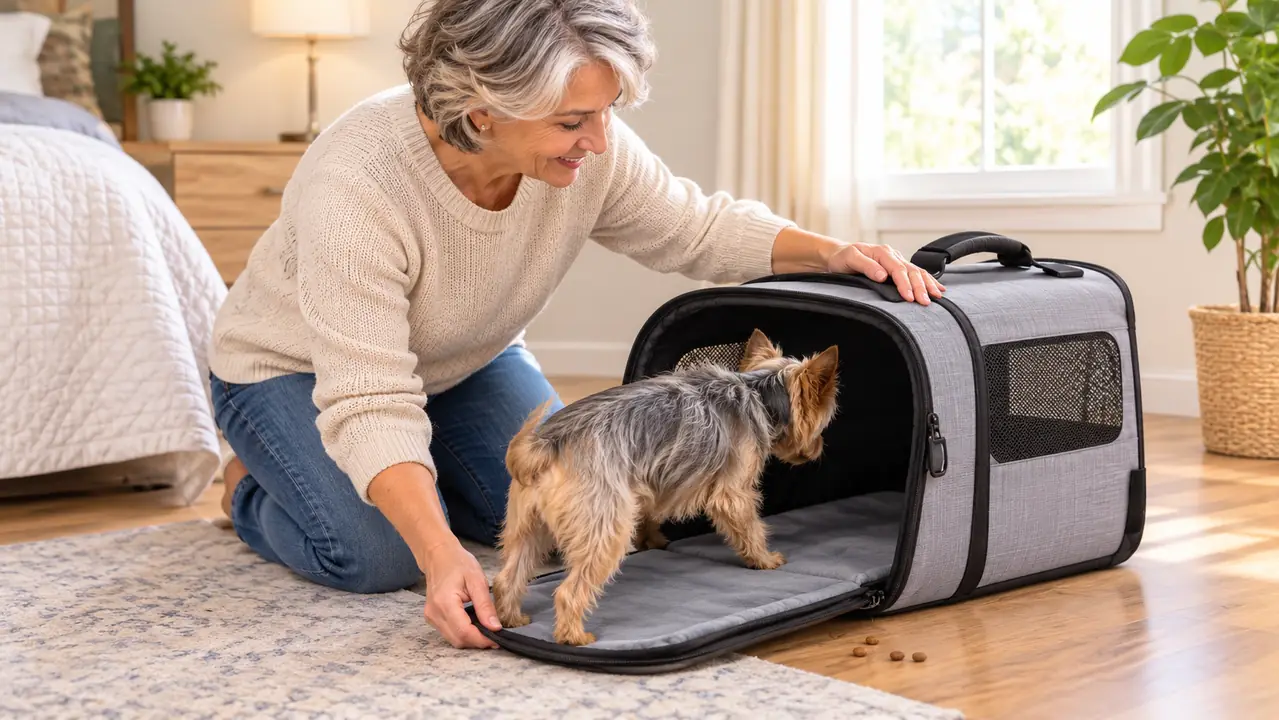
The way I introduced it was not clever. I unzipped the carrier, set it on the bedroom floor with the liner in, and left it there for two weeks. I dropped a piece of kibble in it now and then. Pico is eight and anxious in new places and he shakes when the car first starts, so I was not going to win him over with a grand entrance. By the end of the first week he was napping in it with his chin hooked over the edge. That was the entire training program, and it worked.
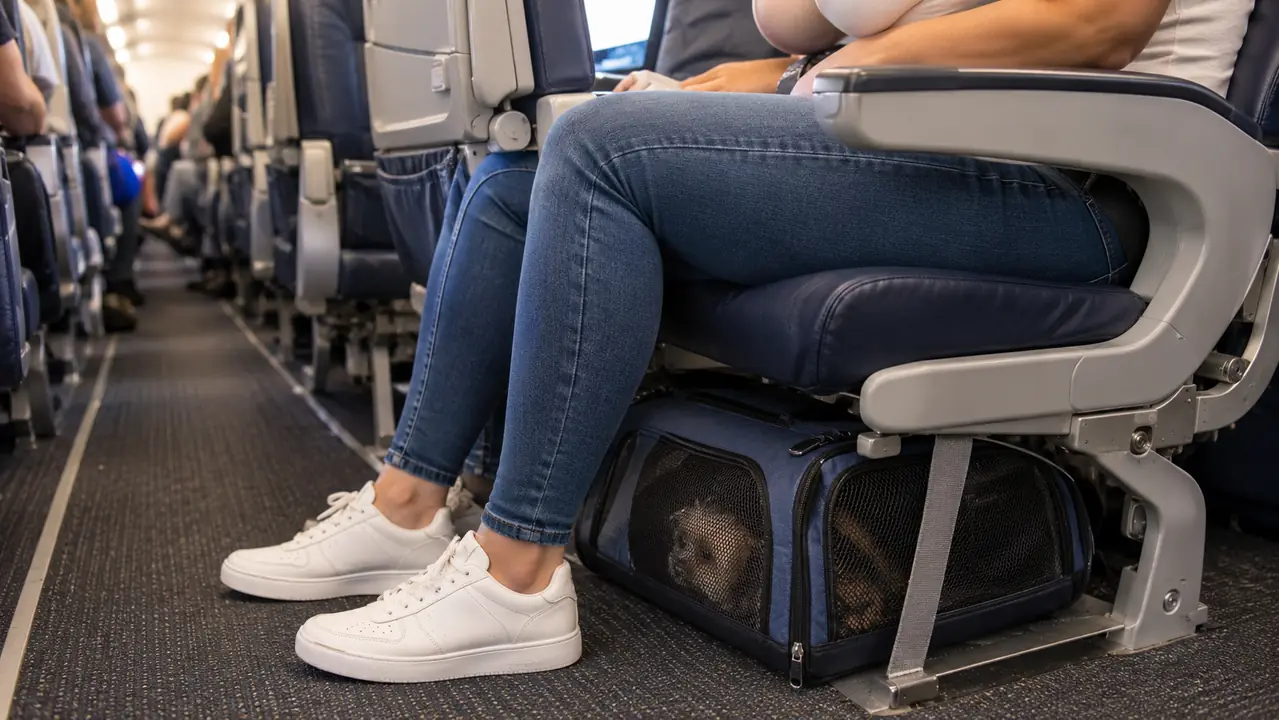
The flights were the real test. Three round trips to Sacramento, always under the seat in front of me, never in the overhead and never checked. The rear of the carrier pushes down several inches because of the spring wire frame, and that is the one feature that actually got it under the seat. I want to be honest about the margin, though: there is not much of it. On one flight the space in front of me was tighter than the others, and I had to work the back of the bag down with my foot while a flight attendant watched me do it. She did not say anything. She did watch.
The first flight was the one I worried about. I got to the Tucson airport two hours early because I had read that the desk might want to see the dog out of the bag, and I wanted time to deal with it if they did. Nobody asked. I kept the carrier on my lap in the waiting area with the top zipped and my hand resting on the mesh, and Pico settled after about ten minutes, which for him is fast. What I had not thought through was security. The carrier goes through the machine, which means the dog comes out of it, which means you are standing in a security line holding a Chihuahua. Nobody was unkind about it. But it is worth knowing before you are in the middle of it, because it is a thing that is happening to you in public.
At the vet it does exactly what a carrier should. It sits on the bench in the waiting room, Pico can see out, and I can reach in through the top opening to settle him without unzipping the whole thing and letting him bolt. The liner comes out, which matters more than I expected, because a nervous dog in a waiting room is not always a tidy dog. I have washed that liner more times than I want to admit in public.
Between trips it lives on the closet shelf at home, folded flat, which takes up about as much room as a folded sweater. That sounds like a small thing until you have owned a molded kennel and had to find somewhere to put it. Fourteen months in, there is no pulled stitching, no torn mesh, and the zipper still runs clean. Those are the three things I watch for on any bag with a zipper, and none of them have gone wrong yet.
There is not much margin under an airplane seat. The spring wire frame gives you several inches, and several is the operative word.
The Spring Wire Frame Is the Whole Point
Strip away everything else and this carrier is a patented spring wire frame wrapped in fabric. That frame is what lets the back end compress down several inches when you push it, and it is the reason the thing measures 15 inches long, 10 inches wide and 8.5 inches tall while still being soft enough to give where a rigid kennel would stop dead. If you are comparing this to a hard-sided carrier, you are not really comparing two bags. You are comparing a bag that deforms to fit with a box that does not.
The way it works in practice is that you load the dog, set the bag down in front of the seat, and then press the rear of it toward the bulkhead with your foot or your knee. The wire frame bends, the back end drops, and the whole thing gains the couple of inches it needs. Once you let go, the frame pushes back out to its shape. That last part matters more than I expected. A bag that bends and stays bent would be a bag that flops around under the seat for three hours. Mine has come back to its shape every time, and I have done this six times now, both directions on all three trips.
The rest of the hardware is plain, and I mean that as a compliment. The closure is a zipper. There is a padded top handle for carrying it by hand and a detachable strap if you want it over your shoulder, and I have used both. The shoulder strap is what I reach for in airports, because it leaves a hand free for a boarding pass and a coffee. The top handle is what I use getting in and out of the car at the vet.
It weighs a pound. Sixteen ounces. When you are the person carrying a dog through two terminals and a tram, a pound of bag is a pound you are not carrying in a shell. Pico weighs nine pounds, so the two of us together are ten, and I can carry that all day without thinking about it. I could not say the same for the molded carrier I borrowed once before I bought this one, and that borrowed carrier is the reason I started looking in the first place.
Where It Genuinely Falls Short
The padding is thinner than it looks in photographs. The bottom has some give and the liner helps, but on a long flight the floor of that bag is not much softer than the carpet under it. Pico shifted around a lot on the second leg of our first trip. I ended up folding a receiving blanket under the liner for later flights and that solved it, but I should not have had to solve that myself.
The blanket is a thin cotton one, folded twice, so it adds maybe half an inch. That half inch is the difference between a dog who settles and a dog who rearranges himself every twenty minutes for three hours. It also eats into the interior a little, which is the annoying part: you are fixing a comfort problem by making a space problem slightly worse. I still do it. I just want you to know that on a nine-pound dog you are choosing between the two and not getting both. If your dog is closer to twelve pounds, I would test the blanket setup at home on the bedroom floor before you commit to it at thirty thousand feet.
The interior is smaller than the exterior dimensions suggest, which is true of every soft carrier and still catches people out. Fifteen by ten by eight and a half is the outside of the bag, and the sides eat into that. A nine-pound dog can lie down and turn around in it. He cannot stand up to his full height, and he cannot do much more than that. On a three-hour flight that is fine. On a cross-country flight I would want to think harder about it before I asked him to spend the day in there.
It has no structure when it is empty, so it does not protect the dog from anything. Somebody steps on it in a crowded jet bridge and the bag gives. The one-year limited warranty covers the bag and not the inconvenience of a seam going at the wrong moment, though to be fair, mine has held up fine and I have not had to test that warranty.
And the shoulder strap, while useful, is not padded enough for a long walk through a big airport. I have done the full length of a terminal with it and my shoulder noticed. If you have a connection in a large airport, plan to switch to the top handle partway. It is a small annoyance, but it is one I have hit on every one of the three trips, so it is not a one-off.
What I Liked
- Fits under the seat in front of you, with the rear pushed down several inches by the spring wire frame
- Weighs a pound, so it adds almost nothing to what you are already carrying
- Zipper closure with a top opening I can reach through to settle an anxious dog
- Padded top handle and a detachable shoulder strap, both of which I actually use
- Removable liner that has survived repeated washing without falling apart
- Airline approved and guaranteed on board, so the bag meets the size most cabin crews work from
- Folds flat for storage on a closet shelf between trips
Where It Falls Short
- Padding on the floor of the carrier is thin without an added blanket
- Interior space is noticeably smaller than the 15 x 10 x 8.5 inch exterior suggests
- No rigid structure, so it offers no protection when set down in a crowd
- Shoulder strap is thin enough that a long terminal walk makes itself known
- Not a car restraint, and it should never be used as one
- One-year limited warranty only
Sizing Is Where People Get Burned
The most common mistake with this carrier is buying it for a dog who is too big and hoping. I have watched people do exactly that in airport lines, with a dog who could not turn around inside the bag, and I have felt sorry for both of them. The listed size is small, the dimensions are 15 by 10 by 8.5 inches, and there is no version of that math that leaves a twenty-pound dog comfortable. Pico is nine pounds and he sits at the upper end of what I would call comfortable in it.
I did the measuring on my kitchen floor on a Sunday, with a cloth tape and a piece of kibble to keep Pico's head down. Nose to the base of the tail, lying flat, he came in just under twelve inches. I measured the inside of the carrier with the liner in and got roughly fourteen and a half inches of usable length, which sounds like plenty until you account for the fact that a dog does not lie in a straight line when he is nervous. He curls. So the number that mattered was not the twelve, it was whether he could curl and still have room to shift position, and at nine pounds he could.
Measure your dog lying down, nose to the base of the tail, add a couple of inches, then compare that number to the interior rather than the exterior. That sounds fussy. It takes two minutes and it is the difference between a bag you use three times a year and a bag you argue about at a gate. Check your airline's own pet policy before you buy anything, too, because the carrier being approved does not override the airline's weight limit or its rules about which routes allow pets in the cabin at all.
One more sizing note that nobody puts in the listing: the bag looks bigger when the dog is in it and smaller when he is not. When Pico is inside and settled, the carrier holds its shape well enough to look like a proper bag. When he is out and it is empty, it collapses in on itself. Neither is a problem. It just means the photograph you see of an empty carrier is not what you will be carrying, and the shape you get depends on the dog.
Who This Is For
This is for the owner of a dog under about fifteen pounds who flies a few times a year and wants a carrier that will not become a scene at the boarding door. It is for someone who wants a bag they can carry by the handle or over the shoulder, who will spend two minutes measuring the interior instead of guessing, and who will do the unglamorous work of leaving it open on the floor for a week so the dog walks in on his own. If that is you, this carrier earns its spot on the closet shelf.
Who Should Skip It
Skip it if your dog is over fifteen pounds, if your dog panics in enclosed spaces and needs more structure around him, or if you are looking for something to secure him in the car. Skip it if you only ever drive. A carrier that comes out for flights and vet visits is a fine thing to own, but it is not the gear that makes road trips easier, and I would rather you spend the money on what you will use every week. And skip it if you want padding you do not have to add yourself, because you will be adding it.
If you fly a few times a year with a nine-pound dog, this is the bag that gets you through
Mine has been to Sacramento three times and to the vet more times than I can count, and it still folds flat on the closet shelf. Measure the interior first. Then buy it once.
Amazon Check Today's Price on Amazon →