I didn't buy a dog seat belt because I thought Pico needed one more piece of gear. I bought one because he tried to climb over the console of my Forester at 65 miles an hour, and I had to choose between grabbing him and steering. He is an 8-year-old, 9-pound Chihuahua mix, and he shakes for the first few minutes of every drive. The COOYOO seat belt tether is the small, simple thing that changed how the back seat works for us. I have used it for 10 months. Here are the ten reasons it has stayed in the door pocket, and the few things I would tell you before you clip one on your own dog.
A seat belt tether is not a harness and not a crash test rating. It is a short nylon strap with a clip on each end. One end snaps to the back ring of a padded harness, the other clicks into the seat belt buckle. The value is in what it stops: the climbing, the sliding, the distracting. I will get to the limits in a minute.
The strap that kept Pico in the back seat, not on my lap
Two adjustable nylon tethers and a collapsible bowl. The COOYOO set clips to a padded harness and buckles into the back seat. I keep one in the Forester and one in my sister's car.
Amazon See the COOYOO seat belt set on Amazon →It keeps a small dog in the back seat, which is the whole point
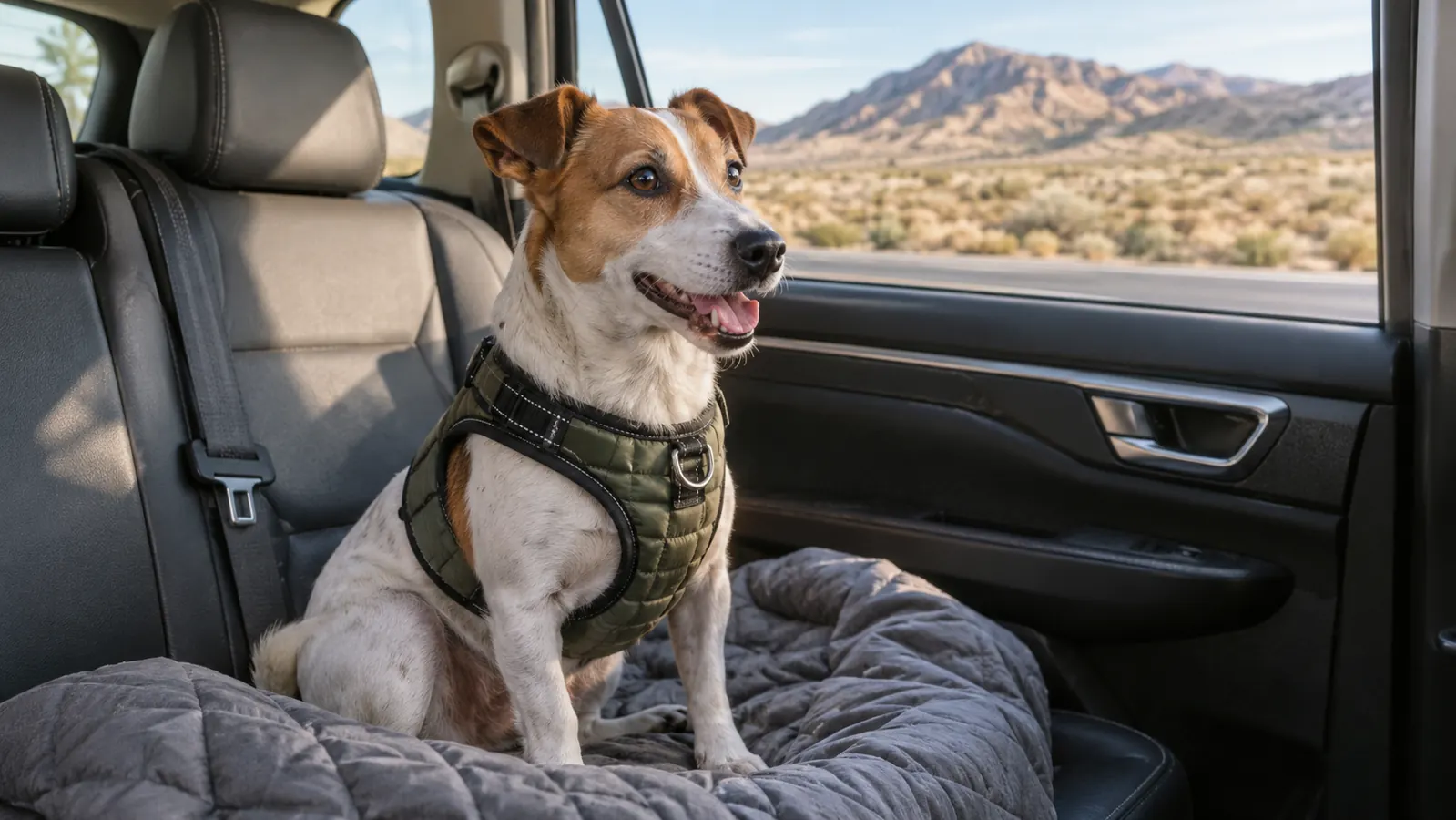
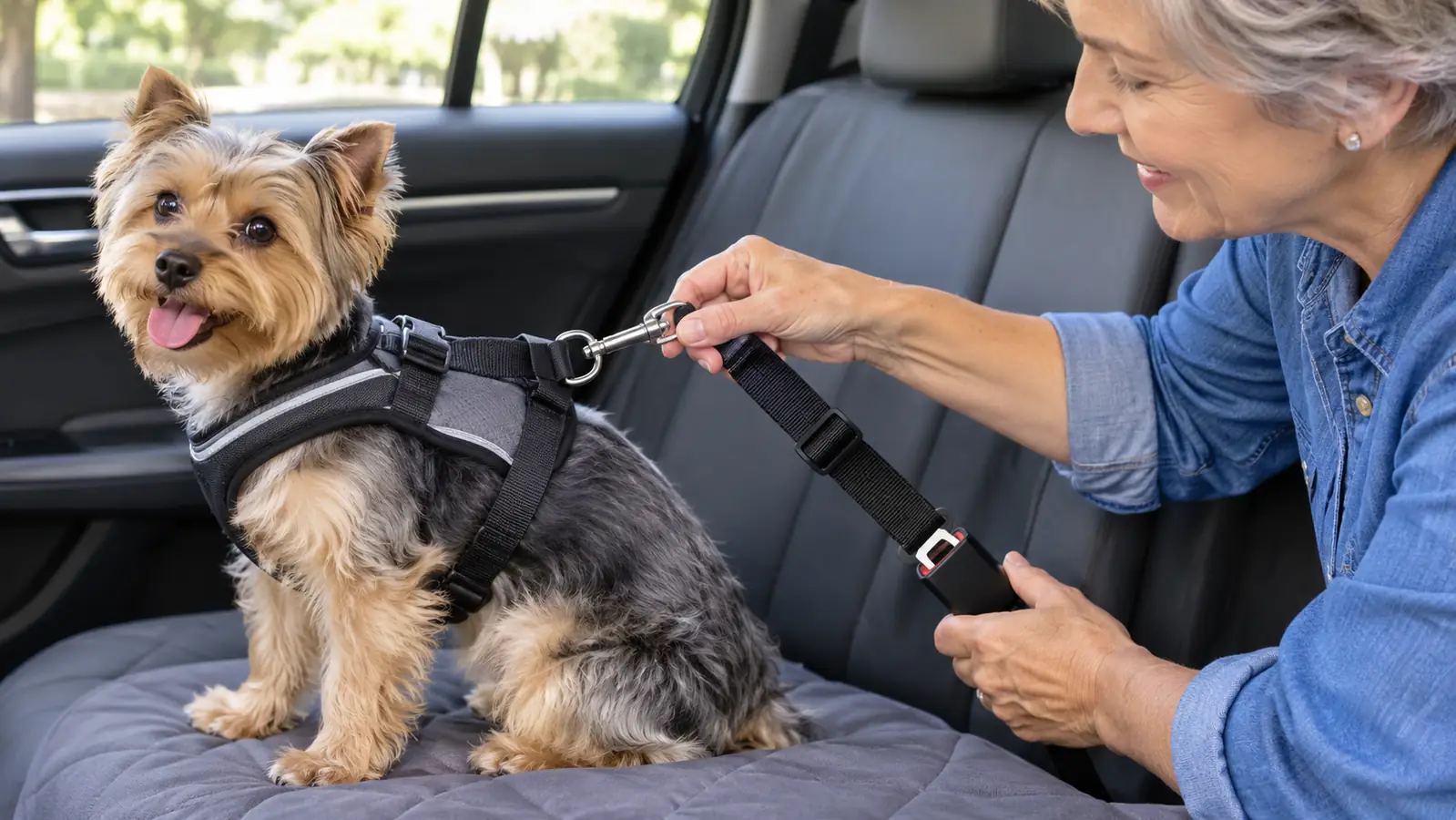
Pico is nine pounds. A nine-pound dog does not need much of a gap to end up on the center console. The COOYOO tether is adjusted to 24 inches in my Forester, short enough that he can sit up, turn around and lie down, but not long enough to reach the front seat. I clip it to the back ring of his padded harness, not his collar. A collar is for a leash, not for a restraint in a moving car.
It stops the climb over the console
The first time he did it, I was merging onto I-10 and he was suddenly under my right arm. I pulled over and sat there shaking worse than he was. With the tether clipped in and shortened, that climb does not happen. He can stand and shift his weight, but the strap runs out before he reaches the console. He still tries. He just does not get there.
It keeps him off the floor and away from the pedals
Small dogs slide. A hard stop sends a nine-pound dog off the seat like a coffee cup. The tether does not pin him down, but it keeps him on the upholstery instead of in the footwell. That matters because the footwell is where the brake pedal lives. I have not had a moment since I started using it where I had to choose between the dog and the brake. That is the only bar I care about on a highway.
It gives him a predictable place, and the shaking gets shorter
Pico shakes when the car first starts. New places, new smells, the engine, all of it. The tether is not a ThunderShirt and I am not a trainer. But the routine helps. He gets in, he sits, I clip the tether, I start the car. Same order every time. In the first week with the COOYOO, the shaking went from about 30 minutes to about 10. Now he usually settles before we hit the end of the street. It is not a cure. It is a cue.
It puts pressure on the harness, not the throat
This is the reason I would buy a tether instead of a simple loop around the seat. The COOYOO clips to the back ring of a padded harness, so the pull lands across his chest and back. If you clip a tether to a collar, a hard stop puts all of that force on the neck. Use a harness. The tether is the short strap between the harness and the buckle. The harness does the work. The tether keeps the harness where it belongs.
The 24 to 31 inch adjustment fits a 9-pound dog without a knot
The COOYOO is adjustable from 24 to 31 inches. That range is the difference between a tether that works and one that is either useless or too tight. At 31 inches, Pico could get a front paw over the console. At 24, he can sit, stand, turn and lie down, but he cannot reach the front. I set it once in my driveway, then checked it again after a week, because nylon stretches and dogs pull. It has held its setting for 10 months.
The 0.79 inch tab fits the Forester's buckle
The tab on the seat belt clip is 0.79 inches wide. That is the number that matters if you have ever bought a tether that would not click into your car. It fits the rear buckles in my 2019 Forester. It also fits the rear buckles in my sister Dolores's car, where the second tether lives when I fly to Sacramento. I still test every buckle in a new car. Push it in, pull it hard, then clip the dog.
The swivel clasp keeps the strap from twisting
The aluminum alloy clasp rotates a full 360 degrees. That sounds like a catalog line until you use a fixed clip for a week. A fixed clip twists the nylon every time the dog turns around, and then the strap is a braided rope with a knot in it. The swivel lets the strap stay flat. It also lets Pico turn in place without wrapping himself up. Ten months in, the clip still snaps shut and the swivel still turns.
Two tethers mean one stays in the car and one travels
The set comes with two tethers and a collapsible silicone bowl. I keep one in the Forester's door pocket and one in my suitcase for Dolores's car. That sounds small. It is the reason I actually use the thing. If the tether is buried in the cargo area under a duffel, I will skip it on a short drive. If it is in the door pocket, I clip it without thinking. The bowl stays in the cup holder on road trips. It is a bonus, not the reason to buy the set.
It is simple enough that I actually use it every time
The COOYOO tether has one job. Clip to the harness, click into the buckle, adjust the length. No app, no battery, nothing I have to dig out of a glove box. I hand wash it with the rest of Pico's gear and let it air dry. That is the whole maintenance routine. The gear that gets used is the gear that is easy to use. This one is easy. That is why it has stayed in the car for 10 months.
What I'd Skip
Skip this if you want a crash tested restraint. I cannot tell you the COOYOO is crash tested, and I am not going to pretend a nylon tether is a car seat. Skip it if your dog chews through straps. Nylon is durable, not indestructible, and a determined chewer can get through it. Skip it if you plan to clip it to a collar. Use a padded harness or do not use it. Skip it if you want to use it at the same time as a booster seat. I do not. When Pico is in his booster, the booster's own safety leash holds him and the COOYOO stays in the door pocket. And skip the bowl if that is the only reason you are buying. It is a nice extra. The tether is the point.
At 24 inches, Pico can sit up, turn around and lie down. He cannot reach the front seat. That is the entire test I needed.
The simple back seat fix that is not a crash test
The COOYOO set is two adjustable nylon tethers and a collapsible bowl. It clips to a padded harness and buckles into the back seat. I have used mine for 10 months. If you want the same setup, the listing is below.
Amazon See the COOYOO seat belt set on Amazon →