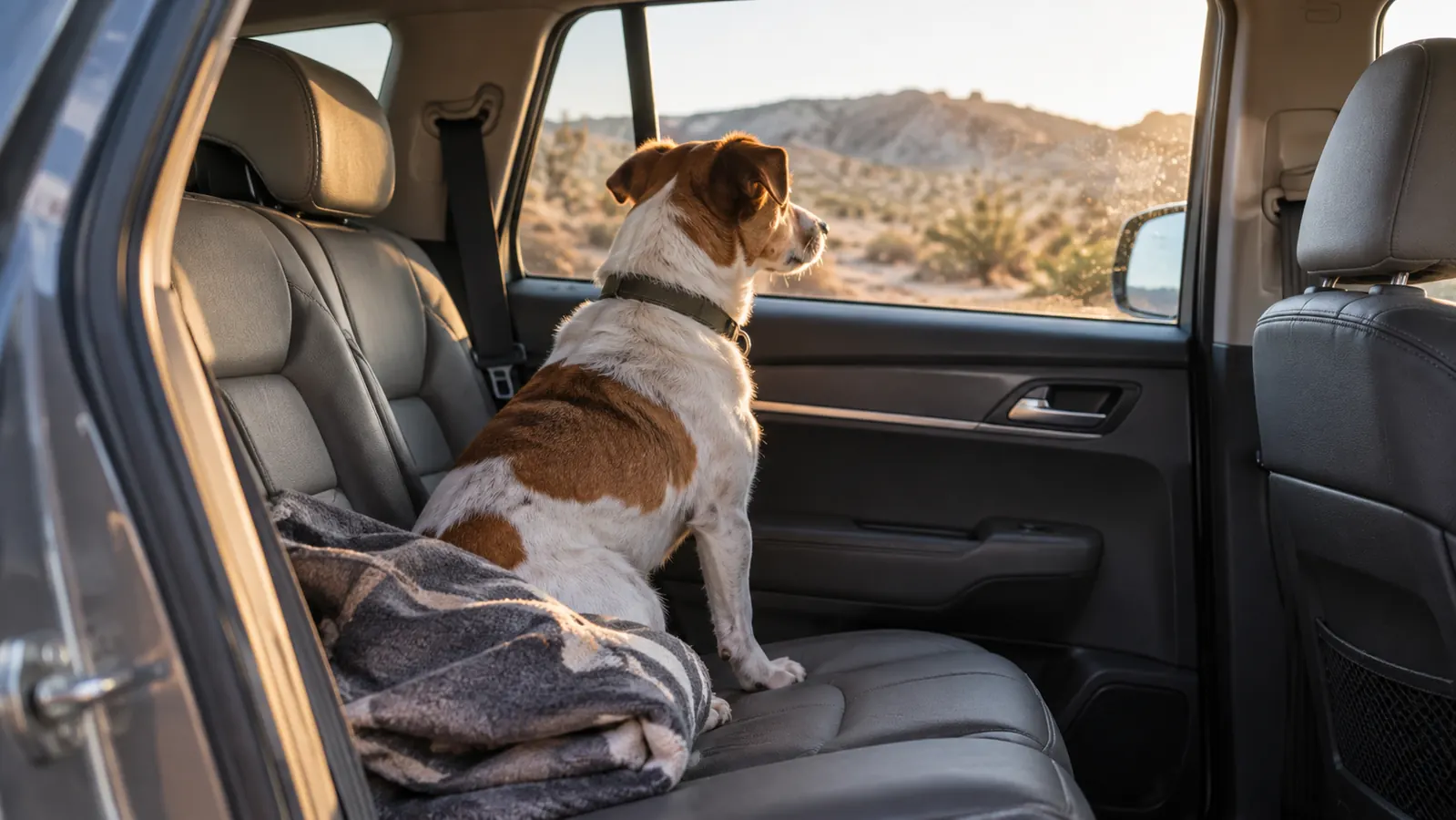
Pico weighs nine pounds. He is eight years old, a Chihuahua mix, and he shakes for the first ten minutes of every ride, so the last thing I want is to wrestle him into something complicated while we are both already wound up. But nine pounds is not the number that matters. The number that matters is what nine pounds becomes when I stop short on the interstate and he does not. I drive a gray 2019 Subaru Forester. Pico rides in the back seat of it, never the front, and somewhere around our third road trip I stopped treating his safety as a thing I would get around to and started treating it as a checklist I run every single time.
The strap I use is the COOYOO dog seat belt, a three piece set that came with two tethers and a collapsible bowl. It clips into the back seat belt receiver, it attaches to the ring on Pico's harness, and it is adjusted short enough that he cannot reach the front seats or the floor. That is the whole system. What follows is not theory. It is the five steps I go through in parking lots, at rest stops and in my own driveway, including the ones I got wrong first.
One Number to Check Before You Order
The COOYOO tether adjusts from 24 to 31 inches, and the tab on the clip measures 0.79 inches. Check that against the buckle in your own back seat, then come back and order the two pack.
Amazon Check Today's Price on Amazon →The Five Steps, In Order
Step 1: Measure the Dog and the Buckle Before You Order Anything
Two measurements and one number off the buckle, and you are done shopping. The first is chest girth, taken right behind the front legs, snug enough that the tape does not slide but not so tight that it dents him. The second is the width of the metal tab on your seat belt buckle. Most people skip the second one, and it is the one that decides whether any of this works in your car. On the COOYOO set that tab measures 0.79 inches, which is sized to fit most vehicle buckles, but most is not all. Walk out to the driveway with a ruler before you order.
Pico sits at the small end of every sizing chart I have looked at, which is why I stopped buying gear sized for a generic medium dog and started reading actual numbers. The tether adjusts from 24 to 31 inches, and that range is what lets it work on a nine pound dog in a back seat while still being long enough for a much bigger dog if you ever need it to be. The strap has some elastic give in it, which matters more than I expected. A completely rigid strap turns every bump into a jolt you feel in your own chest just watching it happen.
The set arrives with two tethers and a silicone collapsible bowl in one box, and that spare is the reason I am not moving one strap between two vehicles every time I visit family. One lives in the Forester's door pocket. The other lives in my sister's car in Sacramento. If you are going to buy one thing for car travel, buy the version that comes with a spare, because the day you need it is not the day you want to be digging through a bag.
Step 2: Harness On First, Tether Second
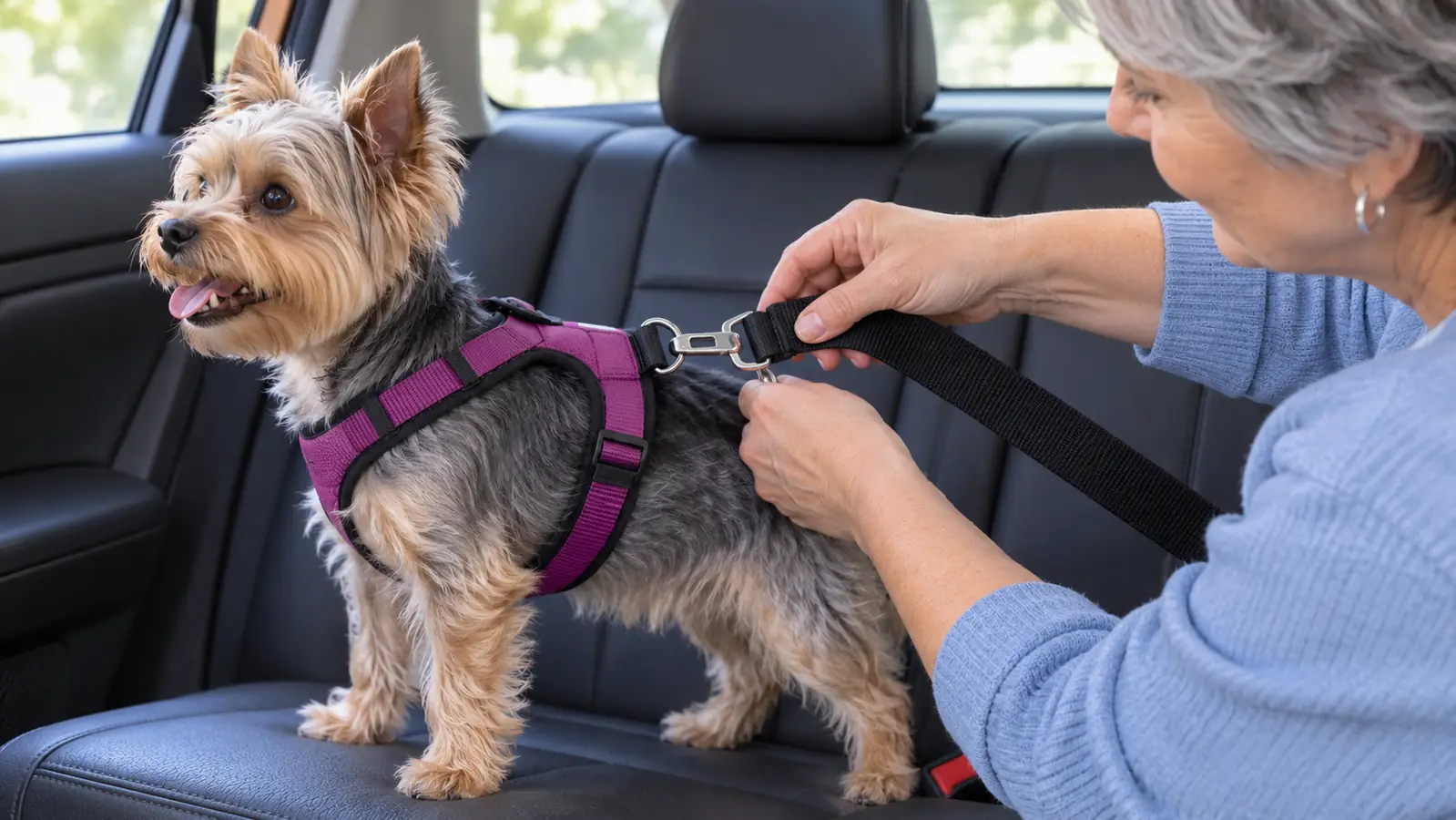
The tether is not a restraint by itself. It is a connector. What holds your dog in the seat is a harness with a metal ring on the back, and the tether simply ties that ring to the car. This is the step people get wrong, usually because they are in a hurry in a parking lot with a dog who is already panting.
Put the harness on the dog before you go near the car. Fit it so you can slide two fingers under the chest strap and no more. Find the ring on the back, the one sitting between the shoulder blades, and give it a real tug to confirm it is stitched into the body of the harness and not just decorative trim. Do not clip anything to a collar. A collar takes force at the throat, and a nine pound dog has a very small throat. I will not put a tether on a collar and I would not do it on a forty pound dog either.
Pico wears a padded harness with a snap closure and a single back ring. The clasp on the COOYOO tether is also a snap, and it opens and closes with one hand, which sounds like a small convenience until you are standing in a motel parking lot in the wind with a shaking dog under one arm. One hand on the clip, one hand on the dog. That is the entire operation.
Step 3: Buckle It In, Then Shorten It
Buckle the tether into the seat belt receiver, the same one a person would use, in the back seat. Then look at how much room you have handed the dog. The adjustment runs 24 to 31 inches, and where you land in that range is the actual point of the exercise. This is the part that separates a strap from a safety setup.
Short enough that he can sit, stand, turn around and lie down. Not so short that he is propped up like he is in a sling, because a dog who cannot lie down will spend the whole trip fighting the strap. And short enough that he cannot reach the front seats or the floor. That last one is the part I care about. A dog who can reach the driver's elbow is a dog who will eventually reach the driver's elbow at the worst possible moment on the worst possible curve.
The clasp on the end of the strap rotates a full 360 degrees, so the webbing hangs straight instead of twisting into a rope. Check for that twist the first few times you buckle it. A strap that has flipped over itself will pull sideways on the harness, and sideways is not the direction you want a nine pound dog being pulled at 60 miles an hour.
The tab on the clip is 0.79 inches wide. That single number decides whether any of this works in your car, so measure it before you order.
Step 4: Run the Parked-Car Test Before You Put It in Drive
Do the first fitting with the engine off. Clip the tether to the back ring, buckle it in, then walk around to the other side of the car and look at your dog from a few feet away. You are checking three things. No twist in the webbing. The snap clasp fully closed and seated. The harness ring lying flat against his back instead of folded over on itself.
Then give a gentle pull. Not a yank, just enough to see that the clip holds and that the ring takes the tension where it should. If the harness spins around when you pull, it is too loose and you need to tighten that chest strap before you go anywhere. If the seat belt buckle pops open easily when you press the release, good. You want to know that it releases cleanly before you ever need it to.
The first drive is where you find out about the shaking. Pico shakes when the car starts. He shook with the tether on the first three or four trips and then settled once he understood the routine, and ten minutes is better than the thirty it used to be. I am not going to tell you a strap cures an anxious dog, because it does not. What I will tell you is that a dog who is not sliding around the seat has one less thing to worry about, and that seems to shorten the whole adjustment.
Step 5: Do the Same Thing on the Four Minute Trips
The drive to the pharmacy is the one people skip, and it is the one I never skip. Most collisions happen close to home, and it is the reason the tether lives in the door pocket where my hand falls on it rather than in a tote bag in the cargo area behind the travel bed and the groceries. Gear you have to dig for is gear you will not use.
When the booster seat is out of the car being cleaned, the tether is what Pico rides with, because the two never go on at the same time. One or the other, never both. The booster has its own safety leash built into it and that is what holds him when he is sitting in it. The COOYOO is the setup for the days the booster is not in the car, and for the back seat of my sister's car when we are running errands in Sacramento.
The webbing is nylon and the care instructions say hand wash only, so about once a month I take the strap inside, wipe it down in the sink with a little dish soap, rinse it, and hang it over the laundry sink to dry. While it is in my hands I look at the stitching at both ends and at the snap clasp. Ten months in, everything is still tight and the clasp still snaps with a solid click. If that ever changes, the strap gets replaced. A car strap is not a thing you nurse along or patch.
What Else Helps
The silicone collapsible bowl that comes in the box has turned out to be the piece I use most, which I did not expect. It flattens down to almost nothing and it lives in the console. At a rest stop on the way up to Colorado I pop it open, pour a little water in, and Pico drinks before we take our walk. A dog who is hydrated is a dog who settles back down in the seat instead of pacing.
The water comes from a Cibaabo bottle, the 300 ml size, which sits in the Forester's cup holder with a small portion of kibble in the food container on the side. It has a bowl part and a filter. It is not fancy equipment, and that is exactly why it works. I hand rinse it at the motel every evening and it is ready again by morning.
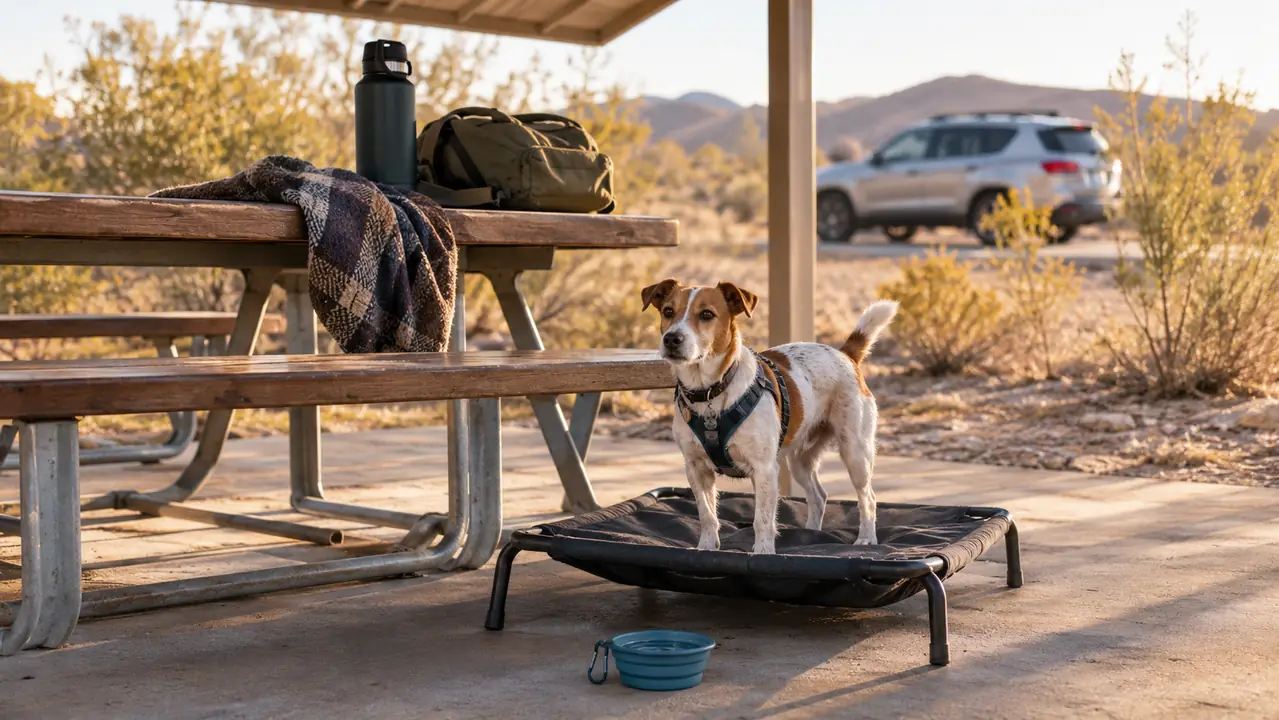
The other two things that earn their space are a travel bed and a booster seat. The Furhaven bed stays in its stuff sack in the cargo area and comes out in every motel room, on the floor beside my bed, and at picnic tables in state parks. The JOEJOY booster sits on the rear passenger side seat, buckled in with its own straps, and lifts Pico so he can see out the window, which is where he rides most days on a long trip. None of these three items does the job of the others. The bed is for sleeping, the booster is for the view, the tether is for the seat belt. I keep them separate in my head and I keep them separate in the car.
The Strap That Lives in the Door Pocket Now
Two tethers, a collapsible bowl, and a clip tab sized at 0.79 inches to fit most vehicle buckles. It is the simplest part of the whole setup, and it is the one I would buy first if I had to start over.
Amazon Check Today's Price on Amazon →